LumberFlow Market Pulse | The 45% Duty Reality and the Eight-Week Supply Grind - Week 6, 2026
LumberFlow Market Pulse for Feb 2-8, 2026: Analysis of 45% Canadian tariffs, Arctic storms in the South, and the 8-week framing lumber rally.
Lumber markets are entering a high-stakes February as a supply-side squeeze overrides cooling macro indicators. With Arctic storms paralyzing Southern production, the 'grind higher' is the new baseline for procurement. This week, we deconstruct why physical constraints are winning the tug-of-war against sluggish consumer confidence.
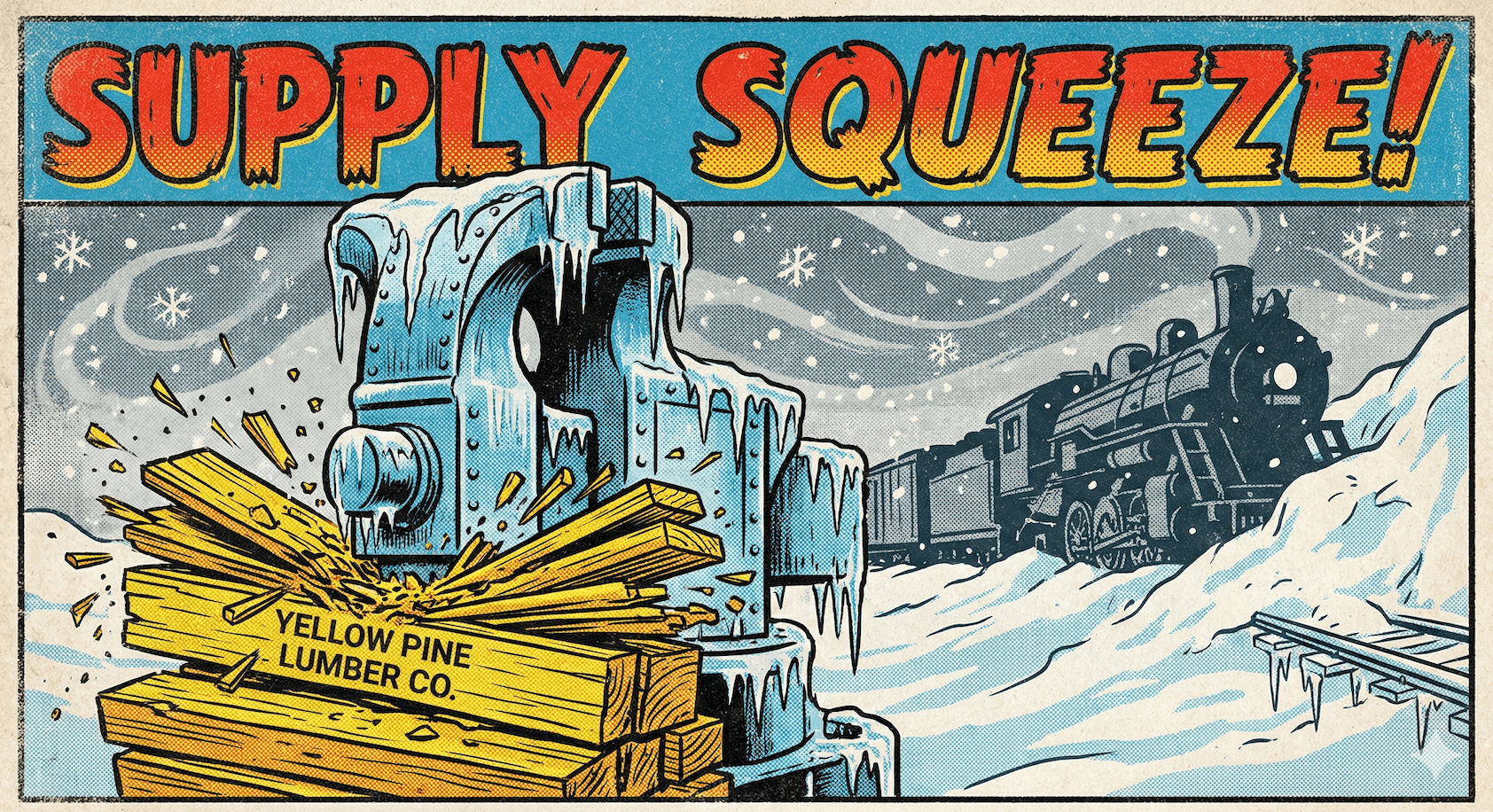
Lumber markets are entering a high-stakes February as a supply-side squeeze overrides cooling macro indicators. With Arctic storms paralyzing Southern production, the 'grind higher' is the new baseline for procurement. This week, we deconstruct why physical constraints are winning the tug-of-war against sluggish consumer confidence.
Macro Snapshot
Macro Indicators & Demand Drivers
- Interest Rate Stasis: Both the US Federal Reserve and the Bank of Canada held rates steady in late January. While this disappointed those hoping for a housing stimulus, it anchors the market in a 'wait-and-see' posture regarding mortgage affordability.
- Inflation Persistence: Goods-sector inflation remains sticky at 2.7%, providing a fundamental floor for industrial commodities and complicating any near-term pivot toward easing.
- Consumer Sentiment Divergence: US consumer confidence hit a 12-year low in January, yet existing home discounts are reaching record levels of 7.9%. This suggests a secondary market that is cooling while the primary construction market faces rising replacement costs.
- Remodeling Outlook: Long-term indicators point to a slowdown in remodeling growth to 1.6% by late 2026, though current backlogs are still absorbing immediate supply.
Industry Highlights
Supply Chain & Production Alerts
- Southern Logistical Paralysis: Sub-zero temperatures across the US South have idled OSB mills and treating plants. Frozen logs and fire suppression drainage have pushed some shipping windows into March 2026.
- Railcar Scarcity: Logistics delays are worsening in the South as winter storms trap cars, preventing the efficient replenishment of distributor inventories.
- Big Box Front-Loading: Major retailers have initiated aggressive spring buying programs, specifically targeting Douglas Fir and Hem-Fir, which is insulating West Coast pricing from seasonal lulls.
- European Species Shift: A 65% surge in European pine shipments is offsetting a decline in Spruce. Buyers relying on Euro-Spruce as a Canadian SPF substitute must now navigate a significantly different product mix.
The Convergence of Trade Policy and Climate Volatility
As we move into the week of February 2, 2026, the North American lumber market is characterized by a persistent upward bias that defies traditional macro-economic gravity. Typically, seasonal lulls or broader economic cooling might suggest a softening of prices, but the current environment is anything but typical. The Framing Lumber Composite has sustained an eight-week rally, gaining $71/mbf since December. What we are witnessing is not a demand-driven surge sparked by a sudden housing boom, but rather a supply-driven "grind" that is tightening the noose on available inventory. The narrative is dominated by the collision of a harsh 45% Canadian duty reality and a series of Arctic storms that have effectively neutralized the production advantages of the US South.
For procurement managers, the math is becoming increasingly complex and unforgiving. The 12-week trend for the Framing Lumber Composite shows a strength of 0.89, trading 11.8% above its moving average. This is a significant deviation from historical norms for early February. While technical indicators like the Relative Strength Index (RSI), currently sitting at 70, suggest we are approaching overbought territory, the physical reality on the ground tells a different story. The technical signals of a "peak" are being drowned out by the sound of empty railcars rattling through the Midwest and the silence of idled mills in the South. This suggests that the price floor is being structurally raised by increased costs and limited availability rather than being speculatively inflated by temporary market exuberance.
The trade policy aspect cannot be overstated. The 45% duty on Canadian softwood lumber has fundamentally altered the cost basis for a significant portion of the North American supply. Canadian producers, who have historically served as the "swing" producers to balance the market, are now facing a cost barrier that makes many operations untenable at lower price points. This has created a vacuum that domestic US production is struggling to fill, particularly when nature intervenes. The Arctic volatility of the past few weeks has acted as a force multiplier for these trade-related constraints, creating a "perfect storm" that is pushing the composite price higher week after week.
Regional Nuances: The SPF and SYP Tug-of-War
In the North, Eastern SPF (ESPF) is showing a 5.2% three-week momentum. While the momentum is technically decelerating compared to the initial post-tariff shock, the volatility regime remains historically high at 11.0%. The "stable" forecast for ESPF this week should not be mistaken for a sign of underlying weakness or a market that has topped out. Instead, it reflects a market that has found a temporary equilibrium as buyers and sellers digest the initial shock of the new tariff implementation. However, this equilibrium is fragile. If Canadian production cutbacks continue to accelerate in response to the duties—particularly in the face of rising energy costs—we expect this stability to give way to another leg higher by mid-February.
Western SPF (WSPF) remains the most volatile and unpredictable segment of the market, currently experiencing a 15.7% four-week volatility. The 8.2% three-week price climb is supported by a strong consensus among market analysts, yet the alignment among buyers remains "partial." This hesitation stems from a growing resistance to the rapid pace of increases; buyers are wary of being caught at the top of a cycle. Nevertheless, the "confirmed" upward signal here suggests that Western producers still hold the upper hand in negotiations. This leverage is bolstered by Big Box retailers who are aggressively front-loading their spring inventories to avoid potential shortages later in the quarter.
Southern Yellow Pine (SYP) presents the most immediate tactical challenge for builders and distributors. Our models show a 78% confidence in an upward signal, a figure driven almost entirely by the sheer magnitude of the Arctic disruption across the Southern United States. This is not merely a matter of cold weather; it is a systemic failure of the supply chain. Mills have been forced to idle to protect fire suppression systems from freezing and bursting, and logs are literally frozen in the yards, making them impossible to process through debarkers and saws.
As a result, the availability of 14-foot and 16-foot lengths—the backbone of residential framing—has essentially vanished from the open market. While our quantitative models suggest a "stable" outlook for the coming seven days based on historical pricing cycles, this is a clear instance where "Facts" (the physical storm) conflict with "Math" (historical price patterns). If the logistics logjam in the South, including the severe shortage of available flatbeds and railcars, is not cleared by February 6, expect SYP prices to break out of their projected stable range and spike aggressively as desperate buyers scramble for remaining tallies.
Quantitative Bias: The Weekly Forecast
Our models suggest a directional bias toward continued strength across the board, though the pace of appreciation may begin to moderate as we hit significant technical resistance levels. The market is currently testing the upper bounds of its current trading range, and the next few days will determine if we enter a new, higher plateau.
- Framing Lumber Composite: UP (53% confidence). The directional bias remains positive, driven by a 2.8% projected weekly uptick. This forecast assumes a gradual return to normalcy in Southern production. Scenario: If the Southern railcar shortage persists past February 5, or if another wave of winter weather hits the transport corridors of the Ohio Valley, the composite will likely exceed the projected 2.8% gain, potentially testing the $500/mbf mark.
- Green Douglas Fir: UP (56% confidence). This species is expected to rise 1.7%. The aggressive buying from West Coast retailers, who are looking to secure supply ahead of the spring building season, provides a solid floor for Douglas Fir. Scenario: If coastal weather remains mild while the interior of the continent remains frozen, Douglas Fir will become the primary substitute for SPF in many applications. This substitution effect could lead to an acceleration of gains that outpaces the broader market.
- Eastern SPF: STABLE (69% confidence). There is high confidence in the current price level as the market pauses to catch its breath. Scenario: This stability is contingent on the absence of new supply shocks. If further mill curtailments or permanent closures are announced in Quebec or Ontario this week, the "stable" outlook will pivot to "up" immediately, as the market reacts to a further tightening of the supply-side vise.
- Southern Pine: STABLE (78% confidence). Despite the high confidence in stability, the 11.8% volatility regime suggests that any move, when it happens, will be sharp and decisive. Scenario: The "frozen log" issue is the wildcard. If these issues at OSB mills spill over into dimensional lumber production more severely than currently anticipated, we will see a supply-side spike regardless of the technical RSI of 70. Procurement teams should monitor the "thaw" in the South closely; a slow thaw is manageable, but a sudden warming followed by mud could further delay logging and keep prices elevated.
Strategic Take: The Cost of Waiting
The "grind higher" is a dangerous environment for procurement managers who rely on the traditional strategy of timing the market for the lowest possible entry point. In a demand-driven rally, buyers can often wait for a correction or a "breather" in the market. However, in a supply-driven grind caused by structural trade barriers and extreme climate events, waiting often results in a double penalty: paying a "logistics premium" on top of the inevitable commodity price increase.
The 45% tariff is a permanent cost layer that has effectively removed the lowest-cost Canadian producers from the competitive landscape. This structural change means that the "old" price floors no longer exist. Simultaneously, we are observing a shift in European imports. Historically, European Spruce acted as a "safety valve" for the North American market when SPF prices climbed too high. However, European producers are increasingly moving from Spruce to Pine to meet their own domestic and Asian demand, removing that traditional relief valve for SPF buyers in the United States.
We are currently operating in a high-volatility regime where the 12-week uptrend strength across all species averages above 0.75. This indicates that the path of least resistance for lumber prices is unequivocally higher. The market is currently "climbing a wall of worry," where every piece of bad news regarding weather or trade is immediately priced in, while good news is viewed with skepticism.
Buyers should treat any "stable" forecast not as a sign that the rally has peaked or that a correction is imminent, but as a narrow window of opportunity to secure volume and ensure job-site continuity. The convergence of the February 6 forecast target and the continued logistical delays in the South creates a critical juncture. Those who wait for a significant pullback may find themselves facing even higher prices and, more importantly, a total lack of available material when the spring building season begins in earnest. In the current market, "price" is becoming secondary to "availability." Securing the tally is now the primary objective of a successful procurement strategy.
How LumberFlow Helps
To navigate this supply-constrained environment, use LumberFlow's procurement planning tools to set automated price targets and monitor the weekly price forecast for shifts in momentum. Our AI-driven supplier scorecards allow you to identify which mills are actually delivering during the Southern railcar crisis, while our daily market insights keep you ahead of trade policy shifts. For a customized strategy on managing the 45% tariff impact, book a consultation with our analysts.
Ready to stay ahead of market shifts? Book a consultation to see how LumberFlow streamlines dimensional lumber buying.
Action Plan for Buyers
- Lock in February Requirements Immediately: Given the 2.8% projected weekly uptick in the Framing Lumber Composite and the 100 RSI in Southern Pine, do not wait for a mid-month dip that is unlikely to materialize due to supply constraints.
- Audit Supplier Logistics: Use the next 48 hours to confirm railcar availability with Southern suppliers. If your primary mills are idled due to the Arctic storm, pivot to Western Douglas Fir or European Pine substitutes before the Big Box spring programs absorb the remaining spot volume.
- Set Price Targets for Q2: Utilize the LumberFlow dashboard to set aggressive price targets for March/April. With Canadian imports down 11%, the spring 'floor' will be significantly higher than in previous years; securing 'early-bird' pricing now is critical.
Related Insights
Continue exploring lumber market analysis


Turn Market Insights Into Action
LumberFlow automates quote tracking, RFQ generation, and supplier negotiations so you can focus on strategic procurement decisions like the ones highlighted in this article.
Need help applying this insight?
Talk with a LumberFlow analyst about procurement playbooks tailored to your SPF program.